What causes odor in hot water?
The most common cause of odor in hot water is the water heater. If your cold water smells fine, check your water heater to ensure that the temperature setting is correct. Water heaters also need to be maintained (see manufacturer’s instructions). Please Contact Us or call our 24-hour customer service number if the odor persists or if it is present in both the hot and cold water.
What should I do if my coffee looks oily?
Clean your coffee maker with vinegar and water as directed by the manufacturer.
Should I buy a home filtration unit?
According to the United States Environmental Protection Agency, home treatment units are rarely necessary for health reasons. Most often, water treatment units are used to remove substances that affect the aesthetic qualities of the water. If you do choose to install a home treatment unit, it is important to follow the manufacturer’s maintenance instructions, because improperly maintained units can actually cause water quality problems.
Should I buy a water softener?
The hardness of water varies with the water’s source. 0-75 ppm hardness is generally considered “soft” water, 75-150 ppm is “moderately hard,” 150-300 ppm is “hard,” and > 300 ppm is “very hard.” The choice to buy a softener is an aesthetic one, since hard water is not harmful to health. However, water softeners typically increase the sodium content of the water, a factor that should be considered by people on low-sodium diets.
What causes the spots on my dishes?
Spots are caused by water hardness minerals (mainly calcium and magnesium), which remain after the water has evaporated. Spots can be eliminated through use of a dishwasher rinse agent.
Why does my water appear milky or cloudy?
A milky or cloudy appearance is usually caused by air bubbles in the water, which pose no health risk. If the water is allowed to sit, the air will dissipate and the water will clear. If the cloudiness does not disappear, please Contact Us so that we may investigate.
How should I prepare for winter?
Freezing weather may bring discomforts, but one of them, frozen water pipes, can be avoided with a little planning and a few simple steps. When frigid arctic air hits, water freezes, and as it freezes it expands—causing pipes to burst and possible flooding to occur.
Pipes that freeze most frequently are those that are exposed to severe cold, such as outdoor hose bibs, swimming pool supply lines, water sprinkler lines and water supply pipes in unheated interior areas such as basements and crawl spaces, attics, garages, or kitchen cabinets. Pipes that run against exterior walls that have little or no insulation are also subject to freezing.
There are several things that people can do to prepare for freezing weather, and there is one important thing everyone needs to know: Determine where the water shut-off valve is in the house and how to use it in case pipes freeze and break.
Before Onset of Cold Weather, Prevent Freezing of Water Supply Lines
- Drain water from swimming pool and water sprinkler supply lines following the manufacturer’s or installer’s directions. Do not put antifreeze in these lines unless directed. Antifreeze is environmentally harmful and is dangerous to humans, pets, wildlife, and landscaping.
- Remove, drain, and carefully store hoses used outdoors. Purchase insulation covers and cover all outside faucets.
- Check around the home for areas where water supply lines are located in unheated areas. Look in the basement, crawl space, attic, garage, and under kitchen and bathroom cabinets. Both hot and cold water pipes in these areas should be insulated. A hot water supply line can freeze just as a cold water supply can freeze if water is not running through the pipe and the water temperature becomes cold.
- Consider installing specific products made to insulate water pipes like a “pipe sleeve” or installing UL-listed “heat tape,” “heat cable,” or similar materials on exposed water pipes. Many products are available at your local building supplier. Pipes should be carefully wrapped, with ends butted tightly and joints wrapped with tape. Follow manufacturers’ recommendations for installing and using these products. Newspaper can provide some degree of insulation and protection to exposed pipes.
- To maintain higher temperatures, add insulation to attics, basements, and crawl spaces.
During Cold Weather, Take Preventive Action
- Keep garage doors closed if there are water supply lines in the garage.
- Open kitchen and bathroom cabinet doors to allow warmer air to circulate around the plumbing. Be sure to move any harmful cleaners and household chemicals out of the reach of children.
- During extreme cold, keep the thermostat set to the same temperature both during the day and at night. If you are going to be away for any period of time, leave the heat set to a temperature no lower than 55 degrees Fahrenheit.
- If you plan to be gone for more than a day, you may have to take other precautionary measures.
How to Thaw a Frozen Pipe Safely
- If your house or basement is flooding, turn off the water valve and call 911. If there is no flooding but you turn on a faucet and only a trickle comes out, make sure your main water valve is turned on. If it is, suspect a frozen pipe. Locate the suspected frozen area of the water pipe.
- Keep the faucet open. As you treat the frozen pipe and the frozen area begins to melt, water will begin to flow through the frozen area. Running water through the pipe will help melt more ice in the pipe.
- Apply heat to the section of pipe using an electric heating pad wrapped around the pipe, an electric hair dryer, a portable space heater (kept away from flammable materials), or by wrapping pipes with towels soaked in hot water. Do not use a blowtorch, kerosene or propane heater, charcoal stove, or other open flame device. Make sure heating pad, hair dryers, or other electrical devices do not come into contact with water.
- Apply heat until full water pressure and flow is restored.
- If you are unable to locate the frozen area, if the frozen area is not accessible, or if you cannot thaw the pipe, call a licensed plumber.
- Check all other faucets in your home to find out if you have additional frozen pipes. If one pipe freezes, others may also freeze.
How do I read my meter?
Reading your water meter will tell you how much water you’re using and whether you have a leak. Most meters are located near the curb in front of your home under a concrete lid. Washington Water uses 100 cubic feet (Ccf) of water as a billing unit, so you should monitor your water usage using these units, as described below.
Dial meters
There are two basic types of dial meters: the straight-reading meter and the round-reading meter.
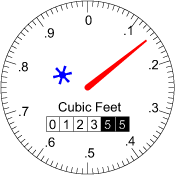 | 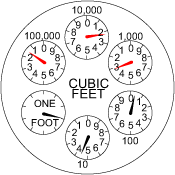 |
| Straight-reading meter (reading: 123 Ccf) | Round-reading meter (reading: 123 Ccf) |
If you have a straight-reading meter, simply read and record the figures shown in white (123). Subtract your last reading from this reading to determine your usage in hundreds of cubic feet. To convert your usage to gallons, multiply by 748. To check for leaks, observe the large sweep or test hand for at least 15 minutes with all water turned off. If there is any movement, there is a leak.
To read the round-reading meter, begin with the dial labeled 100,000 and read clockwise to the dial labeled 1,000. If the hand on any dial is between two numbers, use the lower number. The hands on individual dials may rotate either clockwise or counter clockwise. Subtract your last reading from this reading to determine usage. The “one foot” dial may be used to detect leaks. If there is any movement while all water is turned off for at least 15 minutes, there may be waste occurring.
Digital meters
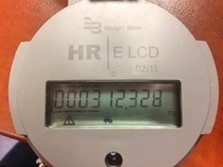
The following will display the four views of the Badger ME and cell registers.
 | 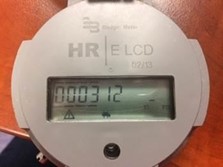 | 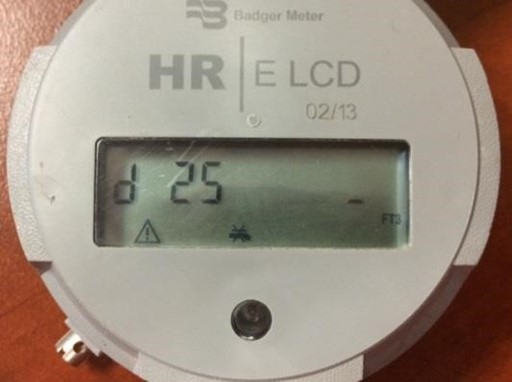 | 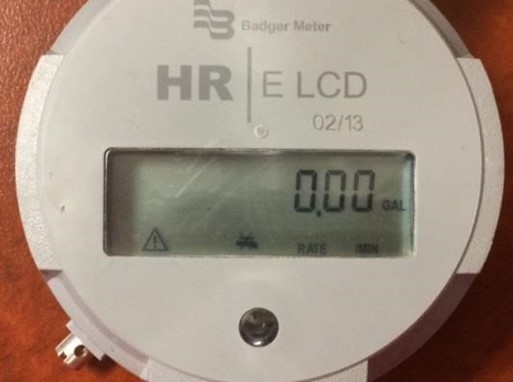 |
| View 1 | View 2 | View 3 | View 4 |
| View 1 shows all of the digits available in the read. Digits with lines above and below are the billing portion of the read, i.e. we bill in increments of 100 cf.—anything below that is not included in the billing. Places to the left of the decimal are ones, tens, hundreds, thousands, ten thousands and hundred thousands. Places to the right of the decimal are tenths, hundredths, and thousandths. | View 2 is an abbreviated view of the read. Digits with lines above and below the billing portion of the read, i.e. we bill in increments of 100 cf.—anything below that is not included in the billing. | View 3 shows the meter model number. This particular meter is a 5/8″, also known as a .625″ meter, so the model number is 25. | View 4 shows the rate of flow in gallons per minute. This particular meter does not have water running through it at this time, so it is not showing a rate of flow. Example: if the meter showed 0.07, then 0.07 gallons per minute are flowing through the meter. |
Examples for calculating consumption:
- Gallons per hour: multiply 0.07 gpm X 60 mins. = 4.20 gallons per hour
- Gallons per day: multiply 4.20 gph X 24 hrs = 100.80 gallons per day
- Gallons per month: multiply 100.80 gpd X 30 days = 3,024 gallons
To effectively monitor your usage, we suggest you read your meter daily or weekly.
Should any special precautions be taken by kidney dialysis patients?
The water you receive from Washington Water is safe for drinking, bathing, and most other purposes. However, if your supply is disinfected with chlorine or chloramine, these substances must be removed from the water before use in dialysis.
What can you do to make sure your water is safe for use in dialysis treatment? Follow these steps.
- See if your water contains chlorine or chloramine. You can find this information in the water quality report for your water system, but you may want to have your water independently tested. You must take steps to remove the chlorine or chloramine from your water before using it in the dialysis process, because these substances are harmful if they enter directly into the bloodstream.
- If your water contains chlorine: Chlorine may be eliminated from water by using a filtration system. To determine whether your system is already able to remove chlorine or to obtain assistance with upgrading your system, contact your physician, dialysis equipment service company, or the Department of Health Services Licensing & Certification Unit.
- If your water contains chloramine: Your dialysis system needs to be able to handle up to 5 mg/liter of chloramine (higher than the maximum concentration allowed by law). Chloramine may be eliminated from water by using a granular-activated carbon-filtration system specifically designed to remove chloramine. To determine whether your system is already able to remove chloramine or to obtain assistance with upgrading your system, contact your physician, dialysis equipment service company, or the Department of Health Services Licensing & Certification Unit.
If you have questions or need additional information on how to prepare your water for use in dialysis treatment, please contact your local dialysis facility or physician.
Should any precautions be taken by pet owners?
The water you receive from Washington Water is safe for human consumption. However, your water may contain chlorine or chloramine, which can harm animals that live in water, such as fish, reptiles, amphibians, and shellfish. Unlike land-dwelling creatures, these animals don’t have a digestive process that neutralizes chloramine and chlorine before it reaches their bloodstream, so putting them in untreated tap water may be harmful—even fatal.
What can you do to protect your pets? Follow these steps.
- See if your water contains chlorine or chloramine. You can find this information in the water quality report for your water system.
- If your water contains chlorine: Chlorine evaporates quickly, so the easiest method of removing it from water is to put it in an open container and let it sit still for a couple of days. Alternately, chlorine may be eliminated from water by boiling it or adding salts.
- If your water contains chloramine: There are two methods for eliminating chloramine from water. You can either purchase a granular-activated carbon-filtration system specifically designed to remove chloramine, or you can use a conditioner or additive containing a dechloraminating chemical for both ammonia and chlorine.
Products for removing chloramine and chlorine, as well as kits to test your water for chloramine, are available at many pet and aquarium supply stores. These stores may also be a good resource for information on care for your pets.