Billing FAQs
Billing
Who is responsible for making repairs?
Washington Water is responsible for repairs within the distribution system. Property owners are responsible for repairs to plumbing on their side of the water meter.
What is the recommended run time for irrigation?
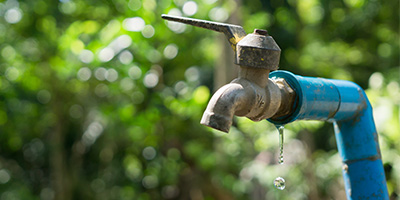 Unless local ordinances specify time limits, we recommend watering 5-7 minutes, 2-3 times per assigned day, to maximize the benefit of irrigation.
How do I program my smart irrigation controller?
Washington Water recommends consulting the user guide provided by the manufacturer to learn how to adjust the programming of your specific controller.
How do I apply for a conservation rebate?
To apply for a conservation rebate on a residential property, visit the Residential Rebates page, complete the Residential Rebate Application and return it by mail.
To apply for a conservation rebate on a commercial property, visit the Commercial Rebates page, complete the Commercial Indoor/Outdoor Rebate Application and return it by mail.
How can I save water in my pool?
- Use a pool cover to reduce water loss from evaporation

- Repair pool leaks. A one-inch-per-day leak in a 15 foot by 30 foot pool can waste about 102,000 gallons per year.
- Manually clean your filter.
- Maintain proper chemical levels and adequate circulation time to avoid needing to either drain your pool or use excess water to correct issues.
- Consider turning off the tile-spray device on an automatic pool cleaner. This device can create splashing and overspray the ends up out of the pool or evaporates before it even hits the tile.
- Reevaluate the frequency of backwashing.
How can I save water in my yard and garden?
It’s always been wise to conserve water in your home and garden, but conservation is more 
than just a good idea—it’s essential. We need to stretch our water supplies to ensure that there is enough water to serve everyone who needs it.
One of the best places to make significant reductions in water us is in your garden. People who live in urban areas use about half their water outdoors. In the summer, garden water use climbs even higher as the weather gets hotter and drier.
Fortunately, you can save water in your garden without sacrificing the quality of your landscaping. By taking advantage of efficient irrigation techniques and using ornamental plants and ground covers that are suitable to long, dry summers, you can enjoy a beautiful landscape that requires significantly less water and maintenance than a less carefully designed one.
Planting Hints
- Whenever possible, plant only low-water and drought-resistant plants. By using native plants—plants that are used to our climate—you may be able to reduce your outdoor water use significantly.
- Limit the amount of area devoted to your lawn. Lawns need great quantities of water, particularly in the summer.
- Wait until fall or winter to install a new garden. New plantings require more water than established growth
- Keep low-water plants away from “thirsty” plants. Mediterranean-zone plants can suffer if they are over watered as you care for their neighbors.
- Keep shade plants in the shade. This will help prevent them from drying out.
- Place water-loving plants at the bottom of slopes, where they will benefit from water runoff.
- Include mulch around shrubs and plants to help reduce evaporation, limit weed growth, moderate soil temperature, and prevent erosion.
- Replace mulch around shrubs and plants at least once per year and remove weeds as needed.
- To understand what kind of soil you have, pick up a handful of moist soil and squeeze it tightly in your hand. Next, try to pinch the soil into a ribbon. If the soil forms a ribbon up to 2″ long, you have clay soil. If the soil forms a ribbon only 1″ long, you have loam soil. Finally, if the soil falls apart easily and won’t make a ribbon, you have sandy soil. Use this information to inform your planting decisions.
- Aerate to reduce thatch (dead grass) buildup in turf areas in spring or fall. Thatch restricts penetration of water, air, and nutrients. Aeration will also increase water penetration in compacted soils.
- Consider using organic fertilizer. Consult a nursery or landscape professional for a well-balance fertilizer program.
Watering Tips
- A good way to check if your lawn needs watering is to just step on the grass. If it springs right back up, you don’t need to turn on the sprinklers. When it’s time to water, do it at dawn or dusk to reduce evaporation
- Mature trees require less water than newly planted ones.
- Check your sprinkler system regularly. A sprinkler system can waste water if sprinkler heads are broken, automatic timers are not adjusted for rain, or hidden leaks are not detected.
- Switch to a drip irrigation system for your yard.
More Outdoor Savings
- A garden hose can use 10 gallons of water per minute. Use a broom instead of a hose to clean patios, walkways, and driveways. When you do need the hose, use a nozzle to increase pressure and decrease water usage.
- Have a dirty car? Use a bucket of water instead of a hose to wash your car. Even better, take your car to a car wash that recycles its water.
- Check the Residential Rebates page for conservation rebates and programs that can help you maximize your outdoor water savings.
Have a suggestion for avoiding water waste? Send it to us!
How do I prepare for a planned water outage?
In advance of the work being done, you may wish to fill a few sanitary containers and pitchers with water for drinking purposes. Filling a bucket or your bathtub with water can be useful for household purposes such as toilet flushing. After this work has been completed and water service has been restored to your home, as a precaution we advise before using water inside, please run your outside hose bib until the water is clear. This is to prevent any discolored water from entering your faucets and fixtures and to evacuate air from your service line.
How do I read my water bill?
Here are detailed instructions on how to understand your new bill, as well as some key features:
- Easy-to-read account summary
- Usage history graph to help you keep track of your consumption
- Detailed description of your charges
- A place for us to include important messages about your water service
- Meter information, including the dates your meter is read
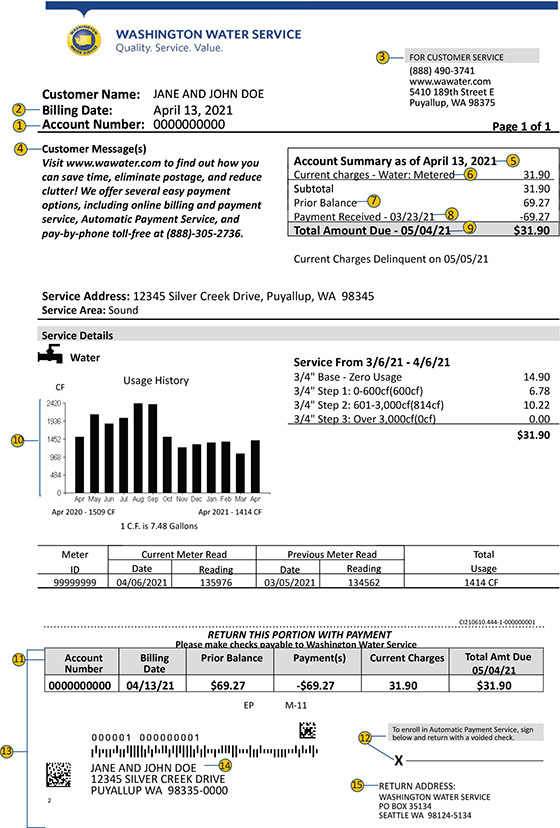
A sample bill is below
 |
Account number: You will be assigned a 10-digit account number |
 |
Billing date: Date your bill was printed |
 |
Contact information: Your local Washington Water Customer Center |
 |
Customer messages: Where important messages will appear |
 |
Summary: Your account billing and payment information |
 |
Current charges: Amount due from current billing period |
 |
Prior balance: Previous balance; includes any unpaid balance; due upon receipt |
 |
Payment received: Payments applied to your account since your last bill |
 |
Total amount due: Amount that you owe, including any unpaid previous balance (all bills due upon receipt and past due after 21 days) |
 |
Water services detail: Graph of your consumption history for the past 13 months |
 |
Summary: Overview of your current bill, including the amount due |
 |
Automatic Payment Service: Instructions for signing up to have your bill automatically paid each month from your checking account |
 |
Portion of bill to return with your payment: Unless enrolled in automatic or online payments |
 |
Billing address: Address to which your bill is sent (this may be different than the service address) |
 |
Payment mailing address: Mailing address for your payment and remit slip |
Is there fluoride in my water?
Washington Water does not add fluoride to the water in any of our systems.
For more general information, see How Does Fluoride Get Into Tap Water?
Is my information secure if I have a cell meter?
Cell meters do not transmit or store personal information. The read and usage data that is transmitted is encrypted.
Where can I find out more about conservation?
We offer a variety of conservation rebates, tips, and resources to help customers save water every day. Visit our Conservation page to learn more.
For more information on Conservation Organizations and Programs:
- EPA: Student Center
- EPA: WaterSense
- United States Geological Survey (USGS): Educational Resources
- USGS: Water Science for Schools
How can schools help conserve water?
 As an education professional, you have a unique opportunity to promote water conservation in your community. You and every other person in your school are a resource—a potential ambassador for conservation. Here are a few suggestions for your school.
- Teachers: Because they interact directly with students, teachers can be effective cheerleaders for conservation. They can seek out water conservation-related projects and activities to keep students aware of conservation and help make it fun. They can also watch for students wasting water—by letting water fountains run or splashing water, for example—and correct the behavior.
- Maintenance Staff: Maintenance employees know the school's infrastructure and are in the best position to spot problems. In addition to responding to complaints about water leaks, they can also proactively search for water waste. This is particularly important in the case of "invisible" leaks, such as those in irrigation systems.
- Students: Students, by virtue of their number, are the "worker bees" of school conservation. They should be encouraged to promptly report leaks and other instances of water waste, and to share what they learn about conservation with their families to help spread the conservation message throughout the community.
- Water Service Providers: Washington Water and other water service providers have programs and materials available to assist schools with conserving water and educating students about water conservation. Contact your local water service provider for more information on what programs and materials are available in your area.
How can I save water in my apartment building?
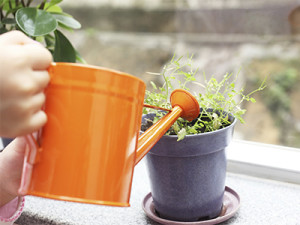 Although apartments generally use less water than houses, in some ways apartment dwellers can do more to conserve water than homeowners. Think of it this way, if everyone in your building does a little something to save water, that small water savings is multiplied by the number of units. So if everyone saves just two gallons of water per day, your building may be saving 10, 50, or 100 gallons per day, depending on the number of units.
Some apartment dwellers pay their own water bills, and some do not. But whether or not you have an individual water bill, it benefits you to conserve water. Conservation helps keep water costs down, and water costs impact the price of necessities such as food (because farms use so much water)—and rent.
- Even if you already have a low-flow showerhead, every minute you shorten your shower can save up to 75 gallons per month. And remember, there's power in numbers—if every apartment in a 15-unit building cut just one minute from their daily shower, that would be a savings of 1,125 gallons every month!
- Got a leaky faucet? Report leaks promptly to your building manager. A little drip may not seem like much, but a faucet that drips just five times per minute may be wasting more than 260 gallons per year.
- Do you leave the faucet running when you brush your teeth? Turn it off to save 70 gallons of water per month or more. You can also ask your building manager to install water-saving faucet aerators to reduce your faucet water use even more.
- See a leaky sprinkler? An apartment building is a community, and what affects the building affects the tenants. If you see a leak—from a broken sprinkler, washing machine, or pipe, for example—report it immediately to your building manager.
- See room for improvement? Your building manager should also be notified if you see other types of water waste. For example, it's best to water lawns when the sun is down to minimize evaporation, so you should inform your manager if an automated watering system's timer seems to be off. You should also bring to your manager's attention old, inefficient washing machines, gardeners who use water to clean walkways instead of sweeping them, and other sources of water waste.
- Have a suggestion for avoiding water waste? Send it to us!
How can I save water in my home?
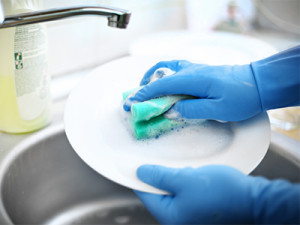
- Is your toilet a water hog? Replacing an old 3½- to 8-gallon-per-flush toilet with a new 1.28-gallon-per-flush (or less) high-efficiency model could save thousands of gallons per year.
- Do you have a leaky faucet? A little drip may not seem like much, but a faucet that drips just five times a minute may be wasting more than 200 gallons of water a year.
- Do you leave the faucet running when you brush your teeth? Turn it off to save 70 gallons per month or more. You can also install water-saving faucet aerators to further reduce your faucet water use.
- Do you like long showers? Even if you already have a high-efficiency showerhead, every minute you shorten your shower can save up to 75 gallons per month.
- Do you have an old washing machine? A high-efficiency clothes washer may use half the water and energy that a traditional washer uses. And don't forget to only run full loads (in your dishwasher, too).
- Install water-saving faucet aerators, high-efficiency shower heads, shutoff hose nozzles, and leak detection dye tablets. We have conservation kits available at no charge to our customers.
- Only wash dishes when necessary. Use both sides of the sink when washing dishes by hand. Use one side to wash and the other side to rinse. Do not wash dishes under a running faucet.
- Keep a bottle or pitcher of drinking water in the refrigerator. This eliminates letting the tap run while waiting for the water to get cold.
- Clean vegetables in a pan of water and not under a running faucet. Water used to clean vegetables can also be used to water houseplants.
- Did you know that in-sink garbage disposal devices use roughly 11.5 gallons of water each day? Try composting organic wastes instead of throwing them away.
- Have a suggestion for avoiding water waste? Send it to us!
Customer Care FAQs
Customer Care
Is my information secure if I have a cell meter?
Cell meters do not transmit or store personal information. The read and usage data that is transmitted is encrypted.
How can I protect myself against utility scams?
 Washington Water occasionally receives reports that scammers pretending to represent Washington Water are targeting customers by phone, by email, or in person. The information below will help you identify and avoid some common scams.
Phone Scams
Scammers may target customers by phone and demand that they make an immediate payment to avoid their service being shut off. These calls are an attempt to defraud by either obtaining credit card information or arranging for a fraudulent payment to be made. Washington Water does not call our customers and demand payment by phone, bank transfer, or other specific payment method.
If you receive a call that sounds suspicious or is about an unpaid bill that you do not believe you owe, hang up the phone and call our Customer Center. Most Washington Water customers can reach our Customer Center at (877) 408-4060. East Pierce customers (formerly Rainier View Water customers) should call (888) 490-3741.
Here are a few things you should keep in mind if you receive a questionable call:
- Scammers can “spoof” a company phone number, meaning that your phone’s caller ID may show that the call is coming from “Washington Water” or “Washington Water Service,” even if it is not.
- Some scammers use automated voice-response systems similar to those used by legitimate pay-by-phone services.
- Washington Water will never ask you to pay your bill using gift cards, pre-paid credit cards, or money transfers.
- Washington Water never shuts off water service for non-payment outside of normal business hours. A delinquent account’s service will not be shut off during the night nor on a weekend.
- If a suspicious automated call asks you to push buttons on your phone for any reason (even to stop future calls), just hang up the phone. Pushing a button on your phone lets the automated system know it reached a live person.
- If you have received a scam call, write down the phone number it came from and contact us immediately so that Washington Water is aware of the situation. The Federal Trade Commission and FCC also have online forms for reporting these types of scams.
Email Scams
Scammers may target customers by email and demand that they make an immediate payment to avoid their service being shut off. These emails are an attempt to obtain credit card information, arrange for a fraudulent payment to be made, or trick the customer into visiting a malicious web site that may infect their computer with a virus or other malicious code. Washington Water does not email our customers and demand payment by a specific payment method.
Scammers may also send emails that appear to be from a utility company, but contain an attachment that will attempt to install malicious code on your computer if opened.
If you receive an email that seems suspicious, has an unexpected attachment, or is about an unpaid bill that you do not believe you owe, do not reply to the email, click any links in it, nor open any attachments. Instead, call us.
Here are a few things you should keep in mind if you receive a suspicious email:
- Scammers can use a fake email address, meaning that a fraudulent email may appear to come from Washington Water, even if it does not.
- Washington Water will never ask you to pay your bill using gift cards, pre-paid credit cards, or money transfers.
- Washington Water will never send you an email with an attachment unless you have requested one.
- Washington Water will never ask you to make an online payment on any web site other than the site linked to on the www.wawater.com home page.
- Washington Water never shuts off water service for non-payment outside of normal business hours. A delinquent account’s service will not be shut off during the night nor on a weekend.
- If you have received a scam email, contact us immediately so that Washington Water is aware of the situation. We may ask you to forward the email to us so that we can investigate it further.
In-Person Scams
Scammers may pretend to be Washington Water employees and visit your home or business in an attempt to obtain credit card information, arrange for a fraudulent payment to be made, convince you to pay for an unneeded service, or gain access to your premises. Washington Water will never ask you to make payment to a specific person or at a specific location, and our employees will not visit your home to collect payment.
Remain vigilant if you are approached by someone seeking payment for your water bill or asking to inspect your water system. If you are ever unsure about someone claiming to be a Washington Water employee, please do not to let him or her into your home, arrange any kind of payment, or provide banking information. Instead, call us for verification.
Here are a few things you should keep in mind if you are approached by someone who claims to work for Washington Water:
- All Washington Water employees carry identification with their photo, name, and the Washington Water logo.
- All Washington Water trucks have the Washington Water logo on the door.
- Washington Water will never ask you to pay your bill using gift cards, pre-paid credit cards, or money transfers.
- Washington Water will never visit your home and ask you to pay your bill using cash or a check.
- Washington Water employees will never visit your home to request access to test your water or check your pipes without making a prior arrangement.
- Washington Water never shuts off water service for non-payment outside of normal business hours. A delinquent account’s service will not be shut off during the night nor on a weekend.
- If you are approached by a questionable person claiming to work for Washington Water, call us immediately so that Washington Water is aware of the situation.
Useful links
How should I prepare for winter?
Freezing weather may bring discomforts, but one of them, frozen water pipes, can be avoided with a little planning and a few simple steps. When frigid arctic air hits, water freezes, and as it freezes it expands—causing pipes to burst and possible flooding to occur.
Pipes that freeze most frequently are those that are exposed to severe cold, such as outdoor hose bibs, swimming pool supply lines, water sprinkler lines and water supply pipes in unheated interior areas such as basements and crawl spaces, attics, garages, or kitchen cabinets. Pipes that run against exterior walls that have little or no insulation are also subject to freezing.
There are several things that people can do to prepare for freezing weather, and there is one important thing everyone needs to know: Determine where the water shut-off valve is in the house and how to use it in case pipes freeze and break.
Before Onset of Cold Weather, Prevent Freezing of Water Supply Lines
- Drain water from swimming pool and water sprinkler supply lines following the manufacturer’s or installer’s directions. Do not put antifreeze in these lines unless directed. Antifreeze is environmentally harmful and is dangerous to humans, pets, wildlife, and landscaping.
- Remove, drain, and carefully store hoses used outdoors. Purchase insulation covers and cover all outside faucets.
- Check around the home for areas where water supply lines are located in unheated areas. Look in the basement, crawl space, attic, garage, and under kitchen and bathroom cabinets. Both hot and cold water pipes in these areas should be insulated. A hot water supply line can freeze just as a cold water supply can freeze if water is not running through the pipe and the water temperature becomes cold.
- Consider installing specific products made to insulate water pipes like a “pipe sleeve” or installing UL-listed “heat tape,” “heat cable,” or similar materials on exposed water pipes. Many products are available at your local building supplier. Pipes should be carefully wrapped, with ends butted tightly and joints wrapped with tape. Follow manufacturers’ recommendations for installing and using these products. Newspaper can provide some degree of insulation and protection to exposed pipes.
- To maintain higher temperatures, add insulation to attics, basements, and crawl spaces.
During Cold Weather, Take Preventive Action
- Keep garage doors closed if there are water supply lines in the garage.
- Open kitchen and bathroom cabinet doors to allow warmer air to circulate around the plumbing. Be sure to move any harmful cleaners and household chemicals out of the reach of children.
- During extreme cold, keep the thermostat set to the same temperature both during the day and at night. If you are going to be away for any period of time, leave the heat set to a temperature no lower than 55 degrees Fahrenheit.
- If you plan to be gone for more than a day, you may have to take other precautionary measures.
How to Thaw a Frozen Pipe Safely
- If your house or basement is flooding, turn off the water valve and call 911. If there is no flooding but you turn on a faucet and only a trickle comes out, make sure your main water valve is turned on. If it is, suspect a frozen pipe. Locate the suspected frozen area of the water pipe.
- Keep the faucet open. As you treat the frozen pipe and the frozen area begins to melt, water will begin to flow through the frozen area. Running water through the pipe will help melt more ice in the pipe.
- Apply heat to the section of pipe using an electric heating pad wrapped around the pipe, an electric hair dryer, a portable space heater (kept away from flammable materials), or by wrapping pipes with towels soaked in hot water. Do not use a blowtorch, kerosene or propane heater, charcoal stove, or other open flame device. Make sure heating pad, hair dryers, or other electrical devices do not come into contact with water.
- Apply heat until full water pressure and flow is restored.
- If you are unable to locate the frozen area, if the frozen area is not accessible, or if you cannot thaw the pipe, call a licensed plumber.
- Check all other faucets in your home to find out if you have additional frozen pipes. If one pipe freezes, others may also freeze.
How do I read my meter?
Reading your water meter will tell you how much water you’re using and whether you have a leak. Most meters are located near the curb in front of your home under a concrete lid. Washington Water uses 100 cubic feet (Ccf) of water as a billing unit, so you should monitor your water usage using these units, as described below.
Dial meters
There are two basic types of dial meters: the straight-reading meter and the round-reading meter.
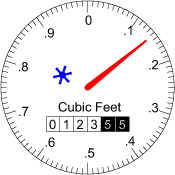 |  |
| Straight-reading meter (reading: 123 Ccf) | Round-reading meter (reading: 123 Ccf) |
If you have a straight-reading meter, simply read and record the figures shown in white (123). Subtract your last reading from this reading to determine your usage in hundreds of cubic feet. To convert your usage to gallons, multiply by 748. To check for leaks, observe the large sweep or test hand for at least 15 minutes with all water turned off. If there is any movement, there is a leak.
To read the round-reading meter, begin with the dial labeled 100,000 and read clockwise to the dial labeled 1,000. If the hand on any dial is between two numbers, use the lower number. The hands on individual dials may rotate either clockwise or counter clockwise. Subtract your last reading from this reading to determine usage. The “one foot” dial may be used to detect leaks. If there is any movement while all water is turned off for at least 15 minutes, there may be waste occurring.
Digital meters
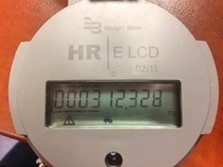
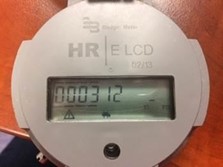
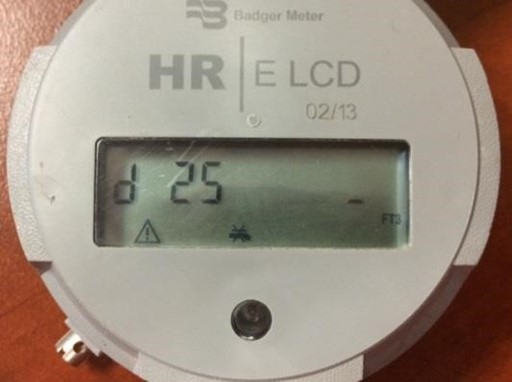
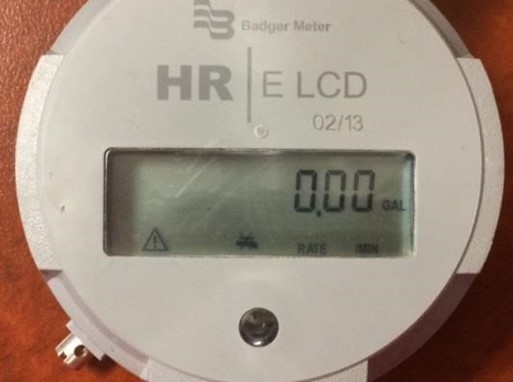
The following will display the four views of the Badger ME and cell registers.
 |  |  |  |
| View 1 | View 2 | View 3 | View 4 |
| View 1 shows all of the digits available in the read. Digits with lines above and below are the billing portion of the read, i.e. we bill in increments of 100 cf.—anything below that is not included in the billing. Places to the left of the decimal are ones, tens, hundreds, thousands, ten thousands and hundred thousands. Places to the right of the decimal are tenths, hundredths, and thousandths. | View 2 is an abbreviated view of the read. Digits with lines above and below the billing portion of the read, i.e. we bill in increments of 100 cf.—anything below that is not included in the billing. | View 3 shows the meter model number. This particular meter is a 5/8″, also known as a .625″ meter, so the model number is 25. | View 4 shows the rate of flow in gallons per minute. This particular meter does not have water running through it at this time, so it is not showing a rate of flow. Example: if the meter showed 0.07, then 0.07 gallons per minute are flowing through the meter. |
Examples for calculating consumption:
- Gallons per hour: multiply 0.07 gpm X 60 mins. = 4.20 gallons per hour
- Gallons per day: multiply 4.20 gph X 24 hrs = 100.80 gallons per day
- Gallons per month: multiply 100.80 gpd X 30 days = 3,024 gallons
To effectively monitor your usage, we suggest you read your meter daily or weekly.
Should any special precautions be taken by kidney dialysis patients?
The water you receive from Washington Water is safe for drinking, bathing, and most other purposes. However, if your supply is disinfected with chlorine or chloramine, these substances must be removed from the water before use in dialysis.
What can you do to make sure your water is safe for use in dialysis treatment? Follow these steps.
- See if your water contains chlorine or chloramine. You can find this information in the water quality report for your water system, but you may want to have your water independently tested. You must take steps to remove the chlorine or chloramine from your water before using it in the dialysis process, because these substances are harmful if they enter directly into the bloodstream.
- If your water contains chlorine: Chlorine may be eliminated from water by using a filtration system. To determine whether your system is already able to remove chlorine or to obtain assistance with upgrading your system, contact your physician, dialysis equipment service company, or the Department of Health Services Licensing & Certification Unit.
- If your water contains chloramine: Your dialysis system needs to be able to handle up to 5 mg/liter of chloramine (higher than the maximum concentration allowed by law). Chloramine may be eliminated from water by using a granular-activated carbon-filtration system specifically designed to remove chloramine. To determine whether your system is already able to remove chloramine or to obtain assistance with upgrading your system, contact your physician, dialysis equipment service company, or the Department of Health Services Licensing & Certification Unit.
If you have questions or need additional information on how to prepare your water for use in dialysis treatment, please contact your local dialysis facility or physician.
Should any precautions be taken by pet owners?
The water you receive from Washington Water is safe for human consumption. However, your water may contain chlorine or chloramine, which can harm animals that live in water, such as fish, reptiles, amphibians, and shellfish. Unlike land-dwelling creatures, these animals don’t have a digestive process that neutralizes chloramine and chlorine before it reaches their bloodstream, so putting them in untreated tap water may be harmful—even fatal.
What can you do to protect your pets? Follow these steps.
- See if your water contains chlorine or chloramine. You can find this information in the water quality report for your water system.
- If your water contains chlorine: Chlorine evaporates quickly, so the easiest method of removing it from water is to put it in an open container and let it sit still for a couple of days. Alternately, chlorine may be eliminated from water by boiling it or adding salts.
- If your water contains chloramine: There are two methods for eliminating chloramine from water. You can either purchase a granular-activated carbon-filtration system specifically designed to remove chloramine, or you can use a conditioner or additive containing a dechloraminating chemical for both ammonia and chlorine.
Products for removing chloramine and chlorine, as well as kits to test your water for chloramine, are available at many pet and aquarium supply stores. These stores may also be a good resource for information on care for your pets.
How can I tell if my toilet has a leak?
To find out if your toilet leaks, listen for the sound of running water. You can also place a few drops of food coloring in the tank. Don’t flush the toilet. If the coloring is seen in the bowl, the toilet is leaking.
How do I discontinue or transfer my service?
See the Start/Stop Service page for instructions.
How do I turn off the water supply to my house?
You can interrupt the flow of water to your home by turning off your house valve. House valves are usually located beneath a faucet outside the home, most typically near the faucet for the garden hose. (See the How to Shut Off Your Water page for more information.) If you cannot find your house valve, please call our Customer Service Center at our toll-free number for assistance.
Who is responsible for plumbing leaks?
The Washington Utilities and Transportation Commission only authorizes Washington Water to take responsibility for the water system on the Company’s side of the meter. Customers are responsible for maintaining the plumbing on their side of the meter.
- 1
- 2
Water Quality FAQs
Water Quality
How do I prepare for a planned water outage?
In advance of the work being done, you may wish to fill a few sanitary containers and pitchers with water for drinking purposes. Filling a bucket or your bathtub with water can be useful for household purposes such as toilet flushing. After this work has been completed and water service has been restored to your home, as a precaution we advise before using water inside, please run your outside hose bib until the water is clear. This is to prevent any discolored water from entering your faucets and fixtures and to evacuate air from your service line.
Is there fluoride in my water?
Washington Water does not add fluoride to the water in any of our systems.
For more general information, see How Does Fluoride Get Into Tap Water?
What is hard water?
Hardness is a measure of the magnesium, calcium, and carbonate minerals in water. Water is considered soft if total hardness is less than 75 ppm, moderately hard at 75 to 150 ppm, hard at 150 to 300 ppm, and very hard at 300 ppm or higher. To convert the hardness of your water from parts per million to grains per gallon, simply divide by 17.1.
Water’s hardness varies with its source. Hard water is not harmful to health, so the choice to buy a water softener is an aesthetic one. However, people on low-sodium diets should be aware that many water softeners increase the sodium content of the water.
The hardness of your water is listed in your annual water quality report.
What is water main flushing?
At Washington Water, we conduct periodic flushing as part of our ongoing water quality and water system maintenance program. By opening certain fire hydrants under controlled conditions, we remove minerals and sediment that build up in water lines over time.
This improves water quality and increases the amount of water that can flow through the water lines.
Although it may seem wasteful to the casual observer, flushing is actually an important and necessary water utility activity that is endorsed by the American Water Works Association and conducted in accordance with guidelines set by the Washington State Department of Health.
You will continue to receive water while we are flushing, but the pressure might be lowered temporarily. If you notice any discoloration and/or sediment in your water after we have flushed, please allow water to run from your outside hose bib until it clears.
Why does the taste of my water change?
In some of our service areas, water sources change at certain times of the year due to the availability of supplies. Surface water, or water that comes from sources like rivers and lakes, tends to taste slightly different than water pumped from underground aquifers.
Why is there dirt or sand in my water?
Dirt or sand can occur naturally in groundwater or as a result of a water line repair. We try to reduce the instances of dirt or sand in the water through regular flushing, which improves water quality by increasing the circulation of water in the pipes and removing most of the sediment from the water.
Why do I taste/smell chlorine in my water?
Chlorine is typically added to your water for disinfection purposes (to kill any bacteria that may be present), but can also be used as an oxidant to remove odors such as naturally-occurring hydrogen sulfide (“rotten eggs”) or as an aid in the iron and manganese removal process. To reduce any chlorine taste or smell, try refrigerating your water before drinking. If the chlorine odor or taste is unusually high (i.e., not normal for your water system), please Contact Us and we will check into it.
Why does water need to be disinfected?
Disinfectants are required because they prevent the spread of germs that cause diseases. Years ago, before disinfectants were used for drinking water, diseases such as cholera, typhoid fever, and dysentery were common. Drinking water disinfection has vastly improved the quality and safety of drinking water.
Why are fire hydrants opened?
Washington Water conducts regular water system flushing to remove any mineral build-up and sediment from the pipes and also to ensure that water circulates adequately throughout the system. Fire hydrants may also be opened to conduct fire-flow capability tests.
Is bottled water higher quality than tap water?
Tap water providers and bottled water providers must meet the same water quality standards. In fact, tap water providers are required to conduct more frequent water quality testing and reporting than bottled water providers. Some consumers prefer the taste of bottled water, and some choose bottled water because they have special health needs. But tap water is a much better deal, costing 1,000 times less than bottled water.
- 1
- 2